
09.02.2025 ARE YOU GODZILLA-CURIOUS?!!! With AARON NEUWIRTH and TERENCE JOHNSON!
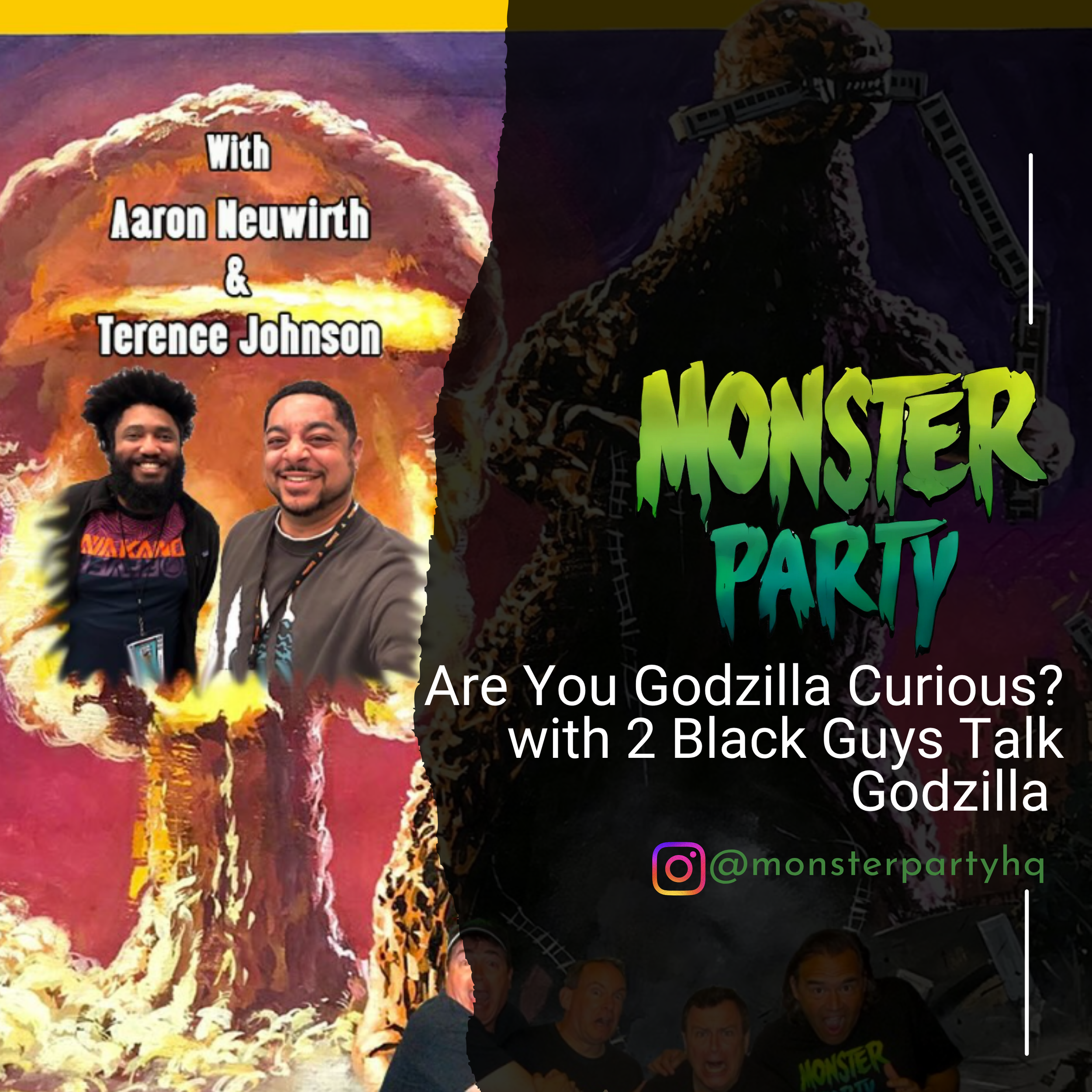
MONSTER PARTY HAS A KAIJU QUERY?
JAMES GONIS, SHAWN SHERIDAN, LARRY STROTHE, and MATT WEINHOLD pose a question that speaks to monster kids of every generation! We just gotta know… ARE YOU GODZILLA-CURIOUS?
Since he first stomped onto the screen in 1954, Godzilla has had a lasting presence in pop culture. Over the decades, he has been portrayed in many different incarnations: embodiment of nuclear devastation, charismatic anti-hero, superhero to children, multi-form menace, and finally… Oscar winner!! And although Godzilla may not be everyone’s cup of sake, there are those chosen elite who see those distinctive back fins and hear that iconic roar, and think, “What makes that kaiju tick?”
In this episode, we’ll discuss Godzilla’s unique appeal, the effectiveness of his colorful enemies and allies (Varan, who may not want to listen to this part), and the constantly-changing stylistic choices that delight and enrage his fans. By breaking down the strengths and weaknesses of the various entries in Godzilla’s long filmography, we’ll attempt to shed light on why Godzilla has managed to maintain his worldwide grip on audiences.
Take your pick: from the grim symbolism of Gojira, the swinging ’60s space vibe of Invasion of the Astro Monster, the “Afterschool Special” lessons of All Monsters Attack, the mind-blowing weirdness of Godzilla vs. Hedorah, the “everything but the kitchen sink “splendor of Godzilla Vs. Biollante, the big-budget mainstreaming of the Legendary Godzilla series, the Dr. Strangelove satire of Shin Godzilla, or the grounded historical drama of Godzilla Minus One. Whatever your taste, Godzilla's got you covered.
Joining us for this audio visit to Monster Island are two very special guests making their MONSTER PARTY debut!
First up, we’ve got a celebrated Rotten Tomatoes-Approved film critic, a member of the Hollywood Creative Alliance and the African American Film Critics Association, and a super hardcore Godzilla fan! His work has been featured in VARIETY, WE LIVE ENTERTAINMENT, WHY SO BLU, FIRSTSHOWING.NET, BATTLESHIP PRETENSION, SCREEN RANT, THE CODE IS ZEEK, and the podcast, OUT NOW WITH AARON AND ABE.
We also have an award-winning filmmaker, who is another Rotten Tomatoes-Approved film critic, a member of the Hollywood Critics Association and the African American Film Critics Association, and the owner of LeNoirAuteur.net! And would you believe, he’s very Godzilla-curious?
And fitting to the theme of this episode, our two guests happen to be the hosts of the always entertaining and informative podcast, TWO BLACK GUYS TALK GODZILLA! Please give an atomic breath-warmed welcome to… AARON NEUWIRTH and TERENCE JOHNSON!
DESTROY ALL ILL-CONCEIVED NOTIONS ABOUT GODZILLA! AND GO EASY ON VARAN.
Guest(s): Aaron Neuwirth & Terence Johnson
Follow Aaron: Aaron Neuwirth (@aaronsps4) | Aaron Neuwirth - Writer | 2 Black Guys Talk Godzilla | Aaron Neuwirth | Substack | Out Now With Aaron and Abe | Aaron Neuwirth (@aaronsps4.bsky.social) | Aaron Neuwirth - Writer | aaronsps4 | Twitter, Instagram, Facebook | Linktree
Follow Terence: Terence Johnson (@terencebjohnson)| Le Noir Auteur | Out Now With Aaron and Abe | 2 Black Guys Talk Godzilla | Aaron Neuwirth | Substack | 2 Black Guys Talk Godzilla
KEY TOPICS DISCUSSED:
Debating the Showa Era (1954–1975): Much of the conversation centers on the films from Godzilla's first cinematic period, with the group sharing their differing opinions.
Son of Godzilla: This film sparks a debate over its tone and the introduction of Godzilla's son, Minya. The group discusses the character's controversial design and the quality of the main Godzilla suit used in the movie.
All Monsters Attack (Godzilla's Revenge): The group has mixed reactions to this film, debating whether its kid-focused plot and dreamlike sequences are effective. They also point out the film's heavy reliance on stock footage from previous entries.
Godzilla vs. Hedorah (The Smog Monster): This entry is highlighted for its experimental style, which is completely different from any other Godzilla film. They note its serious anti-pollution message and its blend of horrific imagery with moments aimed at younger viewers.
A Tour of Kaiju: Beyond Godzilla, the hosts and guests share their opinions on other classic monsters (kaiju). They discuss the unique designs and roles of monsters like Mothra, Ghidorah, Anguirus, Gigan, and Megalon.
Modern Godzilla: Japan vs. America: The hosts and guests compare the creative directions of the Japanese and American Godzilla films.
Modern Japanese Films: Recent Japanese entries are highly praised.
Godzilla Minus One is celebrated as a powerful, character-focused drama, while Shin Godzilla is noted for its satirical take on government bureaucracy and its frightening reinvention of the monster.
American Films: The American-made Legendary MonsterVerse movies are described as large-scale "popcorn" spectacles, while the 1998 Roland Emmerich version is widely considered a failure.
Godzilla's Enduring Legacy: The group concludes by analyzing why Godzilla has remained a cultural icon for 70 years. They credit its longevity to the character's adaptability, its connection to disaster movie themes, and the strong foundation of the original 1954 film.
TIMESTAMPS:
00:02:15 - James, Shawn, Larry and Matt introduce the episode's guests, Aaron Neuwirth and Terence Johnson, who host the podcast Two Black Guys Talk Godzilla.
00:05:08 - Terence Johnson explains the origin of their podcast, which was inspired by a desire to explore the entire Godzilla filmography chronologically after seeing Godzilla Minus One.
00:08:25 - The group begins a lengthy and divisive discussion about the film Son of Godzilla. One of the hosts defends the monster Minya/Manila, while the guests express their dislike for the character's design and the movie's music.
00:14:01 - The conversation shifts to another controversial film, Godzilla's Revenge (also known as All Monsters Attack), with debates on its quality, heavy use of stock footage, and effectiveness as a kids' movie.
00:20:38 - The guests are asked which films from the Showa era they would recommend to a newcomer, with suggestions including the original Godzilla (1954) and Ghidorah, the Three-Headed Monster.
00:35:07 - Looking at the Heisei era, Aaron Neuwirth recommends Godzilla vs. Biollante as a great entry point for new viewers.
00:40:37 - Larry shares a personal story about his excitement for the 1998 Roland Emmerich Godzilla film and how his opinion of it changed over time.
00:44:28 - The discussion contrasts the recent Japanese films, Shin Godzilla and Godzilla Minus One, with the American Legendary MonsterVerse movies, analyzing their different tones and thematic goals.
01:13:14 - The group discusses Godzilla vs. Hedorah (The Smog Monster), praising its bizarre, dark, and innovative style.
01:24:59 - The hosts and guests analyze why the Godzilla franchise has remained so popular and relevant for over 70 years, discussing the character's adaptability and cultural significance.
01:38:20 - The guests provide information on where listeners can find their podcast, Two Black Guys Talk Godzilla.
RESOURCES/LINKS MENTIONED:
Godzilla Films:
All Monsters Attack (also known as Godzilla's Revenge): The hosts and guests have a lengthy debate about this film. Some consider it the worst of the Showa era, calling it "Godzilla versus the stock footage". Others disagree, viewing it as a good kids' movie with a bizarre and fascinating tone, noting the main character is a lonely child in an oppressive industrial city who escapes into fantasy.
Destroy All Monsters: This film is referred to as the "Avengers of the Godzilla" franchise. The guests watched it after viewing the standalone films for Mothra, Rodan, and Varan to be up-to-date on all the monsters involved. They also discuss how Varan has a very brief appearance despite being featured in the film's publicity.
Ebirah, Horror of the Deep: One guest notes that this movie "doesn't do anything for me" and that he wishes it were better each time he watches it.
Ghidorah, the Three-Headed Monster: Aaron recommends this as a good starting point for newcomers to the Showa era because it introduces multiple monsters and a "wacky" plot without going too far into alien-focused stories. The group also discusses a scene where the monsters talk to each other via the Mothra fairies, which one host finds to be one of the "silliest moments". This film marks the point where Godzilla transitioned from a threat to a hero.
Godzilla (1954): Recommended as the essential starting point for any new fan, as it establishes the serious origins and "reason this thing came about to begin with".
Godzilla (1998): The film is heavily criticized, with one guest calling it a "pathetic Jurassic Park wannabe". One host tells a story of being so excited for a big-budget American Godzilla film that he sent gifts to director Roland Emmerich's production company trying to get an internship. He admits he needed to be brought "back to reality" about the film's poor quality.
Godzilla (2014): Mentioned as part of the American Legendary series, which are described as surface-level "special effects spectacles". One guest notes the climax features "three giant monsters who all have the same color scheme fighting amidst at night".
Godzilla, King of the Monsters! (American recut of the original): The guests mention watching this version in addition to the original Japanese cut to understand the differences.
Godzilla: King of the Monsters (2019): One guest mentions he dislikes some of the coloring and monster design choices in this film.
Godzilla Minus One | Decolorized Version: This film is hailed as a "masterpiece" and an Oscar winner. The hosts and guests praise it for being a compelling character drama that resonated with audiences beyond typical Godzilla fans. It is also noted as the inspiration for Terence to start the Two Black Guys Talk Godzilla podcast.
Godzilla vs. Biollante: This film is highly recommended by Aaron as the best entry point for the Heisei era. Multiple people have told Terence that Biollante is their favorite Godzilla movie.
Godzilla vs. Destoroyah: Mentioned as a favorite from the Heisei era, described as "grim and sad."
Godzilla vs. Gigan: While the new kaiju Gigan is praised, the film is heavily criticized for its "egregious stock footage," with one host claiming half the movie is recycled scenes.
Godzilla vs. Hedorah (also known as The Smog Monster): This film is praised for being innovative and completely different from any other in the series. The group discusses its bizarre tone, which mixes nightmarish, horrific moments with animation and scenes aimed at children. One host mentions that seeing Godzilla toys for the first time in this movie changed his life.
Godzilla vs. King Ghidorah (1991): Mentioned as having come out after Terminator 2 and containing a direct reference to it.
Godzilla vs. Megalon: Gigan and Megalon are praised as great monster designs. The character Jet Jaguar is discussed, with the group noting he has become a cool cult favorite after being dismissed for years. A key moment highlighted is when Godzilla and Jet Jaguar shake hands. (BONUS: 2023 Godzilla vs. Megalon short from Godzilla Festival)
Godzilla vs. Mechagodzilla: The guests watched this film on the big screen early in their podcasting journey. It is praised as a "rock solid, cool idea for a kaiju".
Godzilla x Kong: The New Empire: This film is criticized for making Godzilla a "guest starring supporting player in his own franchise". However, one guest notes that Godzilla not being the main feature is common in many of the franchise's films.
Invasion of Astro-Monster: Described as having one of the "craziest movie plots ever," but in a good way. One host says he re-watches it often because of its cool "swinging 60s" vibe, and there is very little Godzilla in it.
King Kong vs. Godzilla: While one guest enjoys the plot, he criticizes the design of the King Kong suit, a sentiment the hosts agree with, stating that Japanese filmmakers in that era could not make good ape costumes.
Shin Godzilla: Described as an "experimental," frightening, and satirical film that skewers Japanese bureaucracy. While praised for its originality and terrifying monster design, there's a debate about whether it's a good recommendation for a total newcomer.
Tokyo S.O.S.: Mentioned as an example of a Millennium Era film that, while not necessarily great, is considered more compelling than the American Legendary films.
Other Films:
Brave: Used as an example of a film with a poorly conceived final battle, comparing its climax of "two Black Bears fighting at night" to the muddy visuals in Godzilla (2014).
Frankenstein vs. Baragon: Mentioned as one of the classic Toho films the guests watched to prepare for Destroy All Monsters.
Frozen: One host jokingly states he prefers Godzilla's Revenge to Frozen.
The Goonies: Referenced to explain how some people who grew up with the 1998 Godzilla movie now feel nostalgic for it, much like fans of The Goonies.
Jaws: A recent Monster Party episode about Jaws is mentioned during a listener review segment.
Jurassic Park: The 1998 Godzilla is called a "pathetic Jurassic Park wannabe" because it tried to make its new monsters cool in the same way Jurassic Park made raptors cool.
King Kong (Peter Jackson's 2005 version): One guest shares a "traumatic story" about watching this three-hour movie on a 105-degree day, without air conditioning, right after having his wisdom teeth removed, only to be confronted by a scene with giant bugs.
King Kong Escapes: Referenced in relation to the poor quality of the King Kong suit used by Toho. Gorosaurus, a monster from this film, also appears in Destroy All Monsters.
The Matrix: Mentioned as a stylistic influence on the film Godzilla: Final Wars.
Mothra: The guests watched the original standalone Mothra film to prepare for Destroy All Monsters. It is also praised as a "beautiful film" that was hugely popular in Japan.
Rodan: The original standalone Rodan was another film watched in preparation for Destroy All Monsters.
Terminator 2: Judgment Day: The T-1000 is compared to Ghidorah as a villain that is nearly impossible to top in subsequent films. It's also noted that Godzilla vs. King Ghidorah (1991) came out after T2 and includes a reference to it.
Uncut Gems: Used as an example to explain context; just as you'd explain the difference between an Adam Sandler comedy and Uncut Gems, you should explain the tonal difference between Godzilla Minus One and Shin Godzilla to a newcomer.
Varan the Unbelievable: The group collectively agrees this is a "dreadful" movie, though the monster design is good. A scene where Varan leaps out of a lake "like a flying squirrel" is singled out for being unintentionally hilarious.
The War of the Gargantuas: Mentioned as another film the guests watched to prepare for Destroy All Monsters.
X-Men (film series): Along with The Matrix, mentioned as an influence on the movie Godzilla: Final Wars.
Television Shows
Courage the Cowardly Dog: The character Minya is compared unfavorably to Courage, who, despite being scared, always finds a way to be brave, whereas Minya rarely does.
Thunderbirds: Two of the hosts mention attending the final days of a Thunderbirds-themed cafe in Japan and getting a souvenir cracker from the experience.
Ultra Q: Referenced when discussing that even in other Toho productions like Ultra Q, the ape costumes were poorly made.
Ultraman: The character Jet Jaguar is noted as Toho's attempt to cash in on the popularity of Ultraman and similar shows.
The Walking Dead: Used as an example of modern media with apocalyptic themes that are popular with audiences, similar to Godzilla.
Comic Books & Characters:
Batman: Used as an example of a character who, like Godzilla, is always around but changes and morphs in how he is presented.
All the Godzilla crossovers - Justice League vs. Godzilla vs. Kong, Godzilla Heist, Godzilla Destroys the Marvel Universe and Teenage Mutant Ninja Turtles Godzilla are among the titles.
DC Comics (in the context of a Godzilla crossover): Mentioned as a current comic book series where Godzilla is fighting DC characters.
IDW Publishing (Godzilla comics): Referenced as one of the publishers creating "wild" storylines for Godzilla in comic form.
Marvel Comics (Godzilla comics): Mentioned as a past publisher of Godzilla comics.
Ninja Turtles (in the context of a Godzilla crossover): Noted as another upcoming comic book crossover for Godzilla.
Video Games:
Mario Kart: One guest jokes that he only swears profusely when playing Mario Kart.
Want more Monster Party?
Patreon Get more from MONSTER PARTY on Patreon
Merch T-Shirts by Monster Party Podcast | TeePublic
Follow Monster Party monsterpartyhq (@monsterpartyhq) | MonsterParty | monsterpartytv
